


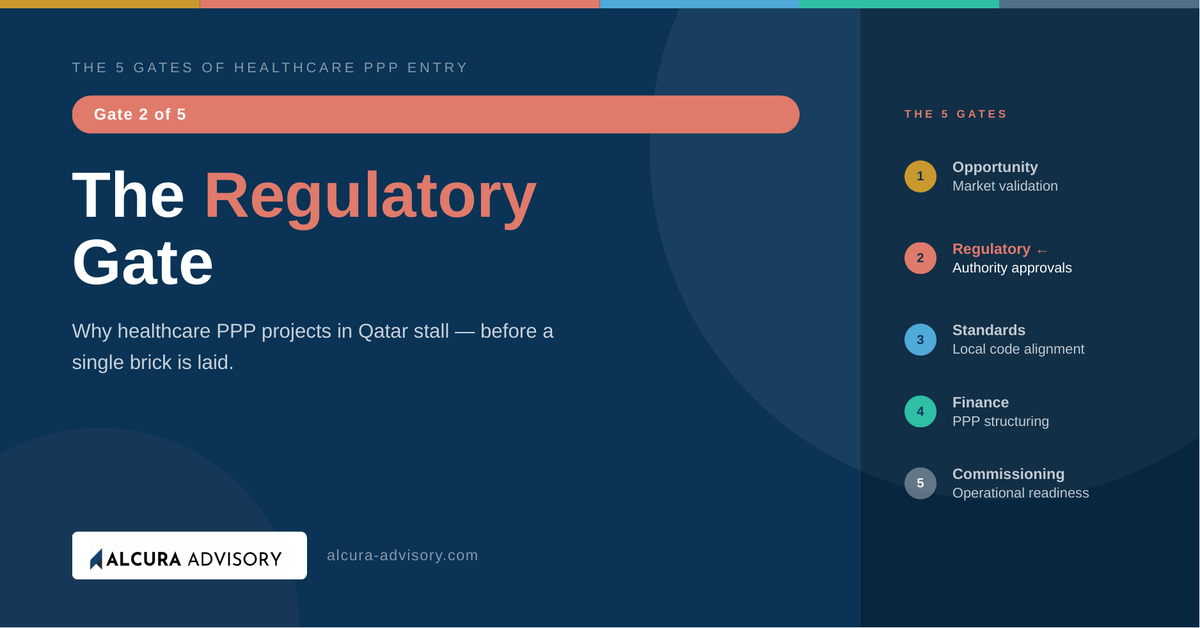
PPP Advisory · June 2026 · The 5 Gates of Healthcare PPP Entry — Gate 2 of 5
Once the opportunity is validated, the regulatory clock starts. Gate 2 determines whether your healthcare PPP project reaches patients on time — or sits in approval limbo for years. Missing this gate causes the longest delays in MENA projects.
Why Gate 2 Comes Immediately After Opportunity Validation
The 5 Gates of PPP Readiness is Alcura Advisory’s structured framework for evaluating and executing healthcare Public-Private Partnership projects across the GCC. Each gate represents a critical threshold a project must pass before moving to the next stage.
Gate 2 — the Regulatory Gate — is where most international operators discover that good intentions and world-class clinical standards are not enough. Qatar’s healthcare regulatory environment is multi-agency, sequential, and unforgiving of projects that treat compliance as an afterthought. The regulatory clock does not pause while you learn the system.
Projects that skip or underinvest in Gate 2 do not fail immediately. They fail at Gate 3 when design standards must be reconciled with approval requirements, at Gate 4 when regulatory delays compress the financing tenor, and at Gate 5 when incomplete commissioning documentation blocks operational licensing. Gate 2 is the foundation that every subsequent gate depends on.
Qatar’s Multi-Agency Approval Environment
Unlike many international markets where a single health authority manages facility approvals, Qatar’s healthcare regulatory framework requires parallel engagement with multiple government bodies. Each authority has its own submission requirements, review cycles, and revision processes — and they do not coordinate on your behalf.
The four primary approval streams that every healthcare PPP project must navigate are:
QCDD
Civil Defence — fire safety, life safety systems, and building compliance from design through commissioning.
MOPH
Ministry of Public Health — facility licensing, service approvals, and operational certification.
Municipality
Building permits, zoning compliance, site use, and environmental requirements.
+ Project-Specific
Ashghal, Kahramaa, and sectoral bodies — identified during Gate 2, not discovered during construction.
Qatar Civil Defence Directorate (QCDD)
QCDD governs fire safety, life safety systems, and building compliance across all stages of a healthcare facility — from design review through construction inspection to operational certification. Healthcare facilities face particularly stringent QCDD requirements given their occupancy profiles and the presence of medical gases, high-value equipment, and vulnerable patients. QCDD reviews are iterative: design submissions are reviewed, comments issued, revisions made, and resubmitted. The number of revision cycles directly determines how long this stream takes.
Ministry of Public Health (MOPH)
MOPH is the primary licensing authority for healthcare facilities in Qatar. It governs facility licensing at design stage, operational licensing at commissioning stage, and ongoing regulatory compliance throughout operation. MOPH approval is required for the service configuration — which clinical specialties can be offered, at what volume, and under what staffing and equipment conditions. A project that designs for one service mix and attempts to license another will face significant rework.
Municipality (Ashghal / Building Permit Authority)
Municipal building permits govern site use, zoning compliance, construction approvals, and environmental requirements. For PPP projects on government-owned or allocated land, the permitting process intersects with the PPP contractual framework, adding a layer of coordination between the municipality, the contracting government entity, and the private operator.
Project-Specific Authorities
Depending on the project’s location, scale, and utilities requirements, additional authorities may be involved — including Ashghal (public works and infrastructure), Kahramaa (electricity and water), and sectoral bodies with jurisdiction over specific facility types or locations. These are often project-specific and must be identified during Gate 2 scoping, not discovered during construction.
The Three Most Common Regulatory Mistakes
In over 30 hospital projects delivered across Qatar’s healthcare sector, the same three regulatory errors appear repeatedly in projects managed without local expertise:
MISTAKE 1
Arriving with designs, not a regulatory roadmap
Most international operators engage designers and engineers before engaging anyone who understands Qatar’s approval process. The result is a design developed to international best practices that must then be adapted to meet local authority requirements — triggering revision cycles that add months. The correct approach is to develop the regulatory submission strategy in parallel with, or prior to, design development. Knowing what QCDD and MOPH will require at each stage shapes design decisions from the outset.
MISTAKE 2
Treating compliance as a final checklist
Regulatory compliance in Qatar is not a checklist completed at the end of design. It is an ongoing process that begins at concept stage and runs through construction, commissioning, and operational readiness. Projects that defer compliance engagement until design is complete face mandatory redesign work. Projects that defer it until construction is complete face partial demolition and reconstruction. Gate 2 establishes the compliance pathway as a live management process, not a document submission event.
MISTAKE 3
Referencing international standards without local reconciliation
International standards — NFPA, FGI, HTM, ASHRAE — are widely respected in Qatar and referenced in design briefs and PPP contracts. But referencing a standard is not the same as reconciling it with Qatar’s local codes and authority requirements. Where international standards conflict with local requirements, or where local requirements impose additional conditions, the project must identify and address these gaps explicitly. Failure to do so results in authority review comments that require redesign — the most common source of regulatory delay in GCC healthcare projects.
How Gate 2 Is Navigated Correctly
A project that has properly engaged Gate 2 before design is completed will have:
- Mapped the full approval pathway across all relevant authorities before design begins — identifying which authority requires what, at which stage, and in what sequence.
- Sequenced submissions across QCDD, MOPH, municipality, and project-specific authorities to run concurrently where possible and avoid cascading delays.
- Embedded compliance requirements into the design brief so that authority requirements shape design decisions rather than forcing revisions after design is complete.
- Identified gaps between referenced international standards and Qatar’s local codes, and resolved them at design stage.
- Established direct working relationships with authority contacts to enable pre-submission engagement, faster review cycles, and early identification of emerging issues.
This is not theoretical. It reflects the practical difference between projects that reach commissioning within planned timelines and those that do not.
What a Passed Regulatory Gate Looks Like
A project that has genuinely passed Gate 2 can demonstrate:
- Regulatory submission schedule — aligned to the project programme, showing what is submitted to which authority at what stage.
- Standards reconciliation matrix — identifying where international standards apply, where local codes take precedence, and how conflicts are resolved.
- Compliance tracking framework — operating throughout design and construction, not just at submission milestones.
- Authority pre-engagement records — demonstrating that key requirements have been clarified before design is finalised.
These outputs become active management tools throughout Gate 3 (standards alignment), Gate 4 (financing), and Gate 5 (commissioning). A regulatory submission schedule produced at Gate 2 directly informs the programme assumptions that financiers rely on. A standards reconciliation matrix produced at Gate 2 directly enables the design compliance process at Gate 3.
The Cost of Getting Gate 2 Wrong
Regulatory delay is consistently the most significant single cause of programme overrun in GCC healthcare projects. In a market where PPP contracts carry performance milestones and delay penalties, regulatory slippage has direct financial consequences — not only in lost revenue from delayed opening, but in liquidated damages, financing cost overruns, and reputational damage with the government counterparty.
The relationship between regulatory delay and project cost is non-linear. A six-month regulatory delay at design stage costs far less to recover than a six-month delay discovered during construction, because the options for compression become increasingly limited and expensive as the project advances.
Gate 2 is not about adding process. It is about protecting the project investment from the single most predictable and preventable source of delay in GCC healthcare PPP delivery.
COMING NEXT IN THE SERIES
Gate 3 — The Standards Gate
Once the regulatory pathway is mapped, every design decision must be made within it. Gate 3 examines how international standards — NFPA, FGI, HTM, ASHRAE — are reconciled with Qatar’s local codes and authority requirements. It’s not enough to reference standards; they must be reconciled. Gate 3 is where many technically excellent projects encounter their first serious delays.
About Alcura Advisory
Alcura Advisory is a specialist healthcare governance, compliance, and PPP advisory firm serving healthcare investors, developers, and operators across the GCC. Our 5 Gates of PPP Readiness framework is built on direct experience navigating healthcare infrastructure projects across Qatar and the wider GCC region — including 15+ years of project delivery spanning design review, commissioning oversight, and authority approvals across more than 30 hospital projects.
Contact: [email protected] | www.alcura-advisory.com
Tags: Advisory | GCC | Healthcare | PPP | Regulatory Compliance