


PPP Advisory · June 2026
The 5 Gates of PPP Readiness — Gate 1: The Opportunity Gate
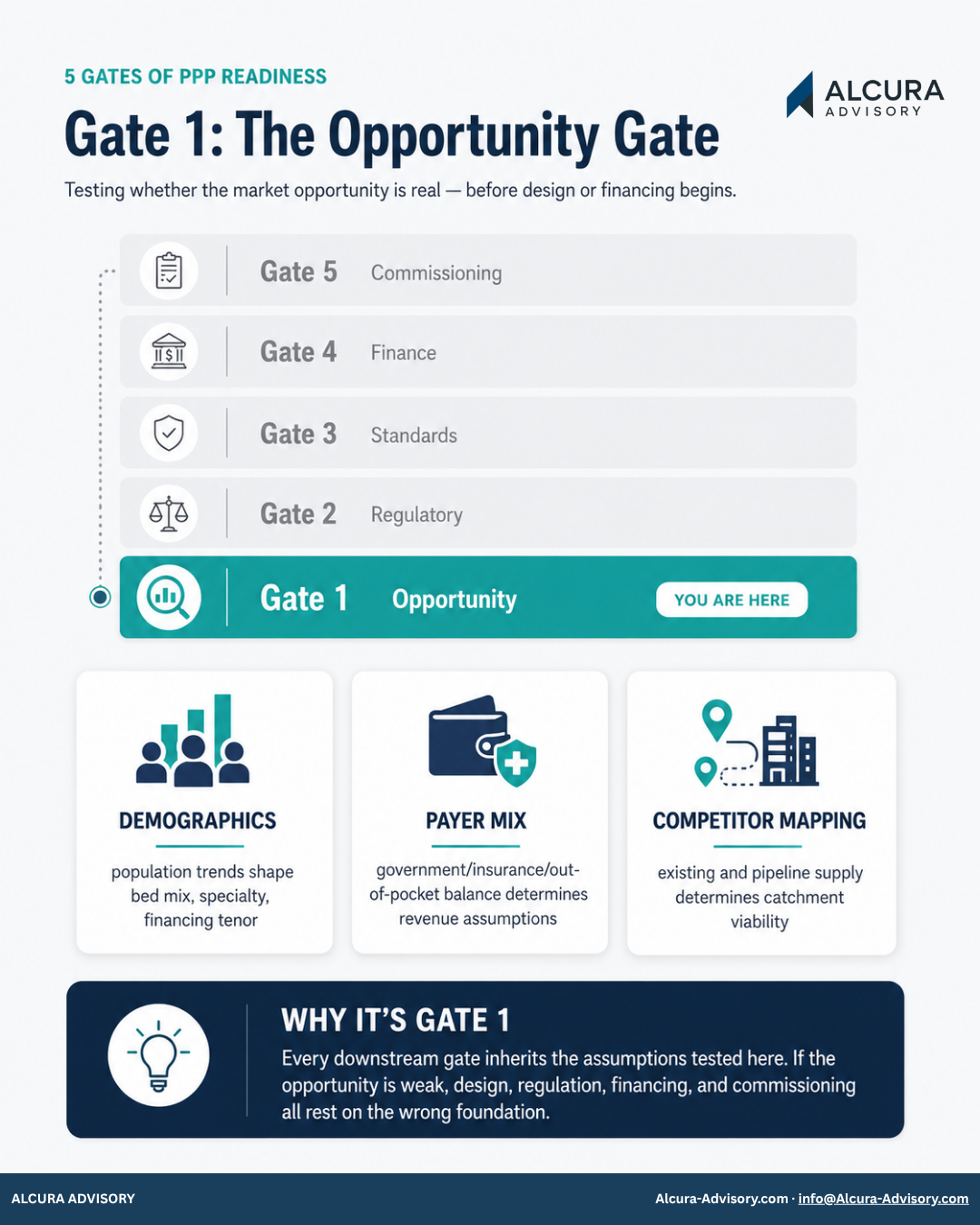
Before a single design drawing or financing model, every successful healthcare PPP in the GCC starts with three fundamental questions. Most projects that fail don’t fail at Gate 1 — they fail three or four gates later, because Gate 1 was never properly tested.
Why Gate 1 Comes First
The 5 Gates of PPP Readiness is Alcura Advisory’s structured framework for evaluating and executing healthcare Public-Private Partnership projects across the GCC. Each gate represents a critical threshold that a project must pass before proceeding to the next stage.
Gate 1 — the Opportunity Gate — is the most foundational. It tests whether the market opportunity is real before design, regulation, financing, or commissioning begins. Every downstream gate inherits the assumptions tested here. If the opportunity is weak, everything built on top of it rests on the wrong foundation.
This is why projects that skip or rush the Opportunity Gate don’t fail immediately. They fail at Gate 3 when standards can’t be met for an undefined patient population, or at Gate 4 when the financing model meets a revenue assumption that was never validated.
The Three Questions Every Opportunity Gate Must Answer
1. Who is the population, and how is it changing?
Demographics are not background information — they are the foundation of every clinical and financial decision that follows. A thorough demographic analysis at Gate 1 examines:
- Population size and growth trajectory — Qatar’s population dynamics differ significantly from Saudi Arabia’s, which differ again from the UAE’s. Each market requires specific analysis rather than regional generalisation.
- Age distribution and chronic disease burden — an ageing population drives demand for long-term care and rehabilitation; a younger population drives maternal health, paediatrics, and primary care
- Catchment area definition — the realistic geographic boundary from which a facility can draw patients, accounting for existing infrastructure, transport links, and competing facilities
- Specialty demand modelling — which clinical services the population actually needs, not which services an investor wants to provide
The bed mix, specialty configuration, and financing tenor of the entire project flow from this analysis. Getting it wrong at Gate 1 means every subsequent decision is built on a false premise.
2. Who pays, and how?
Payer mix is one of the most underestimated variables in GCC healthcare PPP structuring. The balance between government payment, insurance reimbursement, and out-of-pocket payment determines revenue assumptions long before a feasibility study is commissioned.
In Qatar, the government remains the dominant payer through Hamad Medical Corporation and the national health insurance framework — which shapes the revenue model for any PPP facility serving Qatari nationals. In the UAE, the insurance landscape varies significantly by emirate. In Saudi Arabia, the Council of Health Insurance’s shift toward value-based reimbursement is actively reshaping revenue assumptions for new facilities.
A Gate 1 payer mix analysis must address:
- What proportion of the target population is covered by government schemes, employer insurance, or self-pay
- What reimbursement rates apply to the proposed clinical services
- How payer mix assumptions affect revenue predictability and bankability of the project
- How anticipated regulatory changes (such as mandatory insurance expansion) will shift the mix over the project lifecycle
3. Who else is already there?
Competitor mapping is not a formality — it is the difference between a viable catchment and an oversupplied one. The GCC has seen significant healthcare infrastructure investment over the past decade, and the pipeline of planned facilities is substantial.
A rigorous Gate 1 competitor analysis examines:
- Existing supply — licensed and operational facilities within the catchment area, their bed capacity, specialty mix, and occupancy rates
- Pipeline supply — approved, under construction, or planned facilities that will compete for the same patient population within the project’s operational horizon
- Quality and service gaps — where existing providers are underperforming, creating genuine opportunity rather than incremental supply
- Referral network dynamics — how patients currently move through the system and whether the proposed facility can realistically capture referral flows
Investors who skip this analysis often discover at Gate 4 — during financing — that their revenue model assumes patient volumes that the market cannot support. At that stage, the cost of repositioning the project is significant.
What a Passed Opportunity Gate Looks Like
A project that has genuinely passed Gate 1 can demonstrate:
- A clearly defined and quantified patient population with validated demand for the proposed services
- A payer mix analysis that stress-tests revenue assumptions under multiple scenarios
- A competitive landscape assessment that identifies genuine market gaps rather than assumed demand
- A preliminary catchment viability conclusion — does this market support this facility at this scale?
These outputs become the foundation documents for every subsequent gate. They are referenced during regulatory assessment (Gate 2), used to justify clinical standards decisions (Gate 3), presented to financiers (Gate 4), and form the basis of operational planning (Gate 5).
The Cost of Skipping Gate 1
The most common failure mode in GCC healthcare PPP projects is not regulatory non-compliance or financing failure — it is market misalignment. A facility designed for a patient population that doesn’t exist in the numbers assumed, offering services the market already has in abundance, financed on revenue projections that were never validated.
These projects reach advanced development stages before the misalignment becomes undeniable. By then, sunk costs are significant, timelines are compromised, and the options for course correction are limited and expensive.
Gate 1 exists to prevent this. It is not a bureaucratic checkpoint — it is a rigorous commercial and clinical validation that protects every subsequent investment in the project.
Coming Next: Gate 2 — The Regulatory Gate
Once the opportunity is validated, the regulatory clock starts. Gate 2 examines the licensing pathway, authority approvals, and compliance requirements that determine the timeline and feasibility of bringing a healthcare PPP from concept to operation in the GCC.
The regulatory environment varies significantly across Qatar, the UAE, and Saudi Arabia — and misunderstanding it at Gate 2 is one of the most common causes of project delay in the region.
About Alcura Advisory
Alcura Advisory is a specialist healthcare governance, compliance, and transformation advisory firm serving healthcare investors, developers, and operators across the GCC. Our 5 Gates of PPP Readiness framework is built on direct experience navigating healthcare infrastructure projects across Qatar and the wider GCC region.
📩 [email protected]
🌐 www.Alcura-Advisory.com