


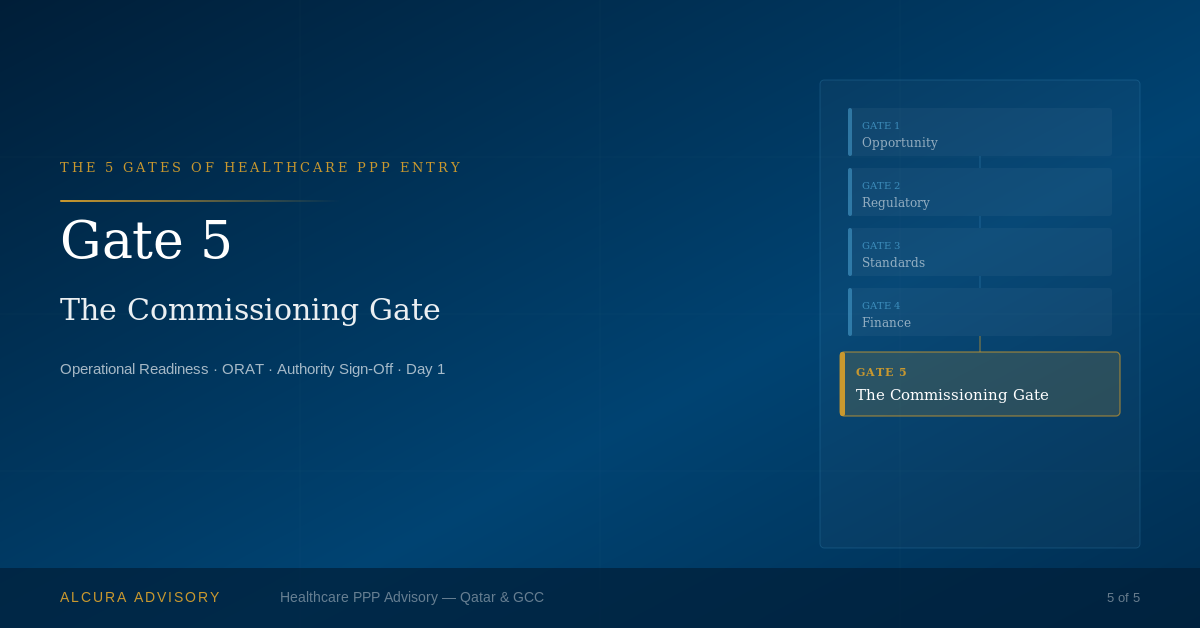
PPP Advisory · June 2026 · The 5 Gates of Healthcare PPP Entry — Gate 5 of 5
Most projects that fail at Gate 5 didn’t fail because of a design flaw or a regulatory gap. They failed because commissioning was treated as a final checklist rather than a parallel workstream — and by the time construction handed over, it was already too late to recover the schedule.
The Work That Happens After Construction
International operators who have successfully navigated Gates 1 through 4 have done the hard strategic, regulatory, and financial work. They have assessed the market, secured authority approvals, reconciled design standards, and structured a financing deal that pencils. They are four gates in.
Then they discover Gate 5.
Commissioning is the phase between construction handover and the day a facility takes its first patient. In most markets, this phase is underplanned, underfunded, and begins too late. In Qatar, it is also subject to a specific sequence of authority inspections, documentation requirements, and regulatory sign-offs that cannot be compressed — regardless of how tight the project schedule is.
The 5 Gates of Healthcare PPP Entry is Alcura Advisory’s structured framework for evaluating and executing healthcare PPP projects across the GCC. Gate 5 — the Commissioning Gate — is where everything built through Gates 1 to 4 is proven on the ground. A financed, regulator-cleared, standards-compliant project still has to actually open. Incomplete commissioning is one of the most common reasons first revenue gets delayed — and in a PPP concession structure, delayed revenue is not a rounding error. It rewrites the financial model.
The Last-10% Problem
There is a pattern that repeats across healthcare PPP projects in the GCC. The first 90% of construction proceeds relatively smoothly — drawings are approved, structure is built, mechanical and electrical systems are installed. Then, in the final phase, everything converges at once.
QCDD final inspection. MOPH operational readiness review. Fire safety certification. Medical equipment validation and installation qualification. QCHP staff credentialing. BMS and ICT integration testing. Handover documentation packages for every system. EMR or HIMSS go-live environment preparation. Each workstream is independently manageable. Run them in parallel without coordination, under schedule pressure, with contractors demobilising and operators not yet fully on site, and they become mutually blocking.
A fire safety inspection finds a door that hasn’t been certified for its installed hardware. An MOPH review reveals clinical protocols that aren’t yet signed off. Equipment commissioning identifies a utilities specification gap that requires a contractor return. Each event pushes the next back. A 90-day commissioning buffer becomes a 12-month overrun — not because anything went catastrophically wrong, but because no one owned the sequencing.
What Qatar’s Commissioning Sequence Actually Requires
Qatar’s commissioning requirements are not arbitrary. They reflect a genuine regulatory framework for protecting patient safety from Day 1 — the same framework that makes Qatar’s healthcare institutions credible internationally. Each workstream below has its own timeline, its own documentation standard, and its own lead time that cannot be shortened by contractor pressure or operator urgency.
QCDD
Final fire and life safety inspection across the completed building. Covers suppression systems, compartmentation, egress routes, and fire-rated door certification. Triggers a reinspection cycle if deficiencies are found.
MOPH
Operational readiness inspection for facility licensing. Requires a facility that already looks, functions, and is staffed like an operating hospital — clinical governance documentation, infection control protocols, and waste management plans must all be in place before the inspection date.
QCHP
Staff credentialing through the Qatar Council for Healthcare Practitioners runs on its own independent schedule. Processing timelines vary by specialty and nationality. No operator can accelerate it — only plan around it, and only if planning starts early enough.
ORAT
Operational Readiness, Activation and Transition — the structured methodology that integrates technical, clinical, and administrative workstreams into a sequenced commissioning program. Without a formal ORAT, the workstreams above run independently and create the blocking pattern that causes overruns.
The Financial Cost of Gate 5 Failure
The economics of a PPP concession make Gate 5 failure disproportionately expensive. Revenue begins when the facility opens — not when construction ends. Every day of delay between handover and first patient is a day of full operating cost with zero revenue: staff on payroll, utilities running, facilities management engaged, interest accruing.
In a 25-year concession, a 90-day commissioning overrun is manageable if it was budgeted. A 12-month overrun — which is not uncommon in first-time PPP commissioning — rewrites the underlying financial model. Lenders and equity investors watch this closely. A project that passed Gate 4’s bankability test can still produce a covenant breach at commissioning if the drawdown timeline and operating cash flow assumptions were built around a clean Day 1 that did not materialise.
The concession clock starts at handover, not at opening
In most PPP structures, the availability or service payment clock begins at construction completion — or shortly after. An operator who spends 12 months commissioning a building they could have been generating revenue from is effectively paying a large premium for a commissioning program that should have been running in parallel for the preceding 18 months. This is the cost of treating Gate 5 as a post-construction activity rather than a parallel workstream.
Why Gate 5 Is Not a Standalone Phase
Gate 5 is not where Alcura’s involvement begins — it is where the accumulated work of Gates 1 through 4 is proven. Every governance structure established at Gate 1, every authority relationship built at Gate 2, every standards reconciliation decision made at Gate 3, every financing structure agreed at Gate 4 has a direct consequence at commissioning.
The facilities that open on time — and without incident — are not the ones with the best construction teams. They are the ones that began commissioning planning early, treated ORAT as a strategic investment rather than a project management formality, and maintained one advisory team across all five gates rather than handing off between specialists at each threshold.
What a properly commissioned project looks like at Gate 5
- ORAT program launched at Gate 3 — commissioning planning begins during the construction phase, not after handover.
- QCDD and MOPH inspection sequences mapped and pre-submitted — documentation packages prepared in advance, not assembled under inspection pressure.
- QCHP credentialing initiated 9–12 months before opening — clinical staff recruitment and licensing running in parallel with physical commissioning.
- BMS, ICT, and EMR go-live tested against live clinical workflows — not against theoretical specifications.
- Handover documentation complete before contractor demobilisation — system-by-system as-built records, O&M manuals, and training packages in place before the site is handed back.
- A single advisory team spanning all five gates — so that commissioning decisions are informed by the authority relationships and governance structures built in Gates 1 to 4, not rebuilt from scratch by a new team at the finish line.
A construction team builds the building. A commissioning program builds the hospital. The difference between those two things is Gate 5 — and the operators who plan for it from Gate 3 onwards are the ones who open on time.
PREVIOUS IN THE SERIES
Gate 4 — The Finance Gate
Qatar’s mandatory health insurance system is fully operational — converting a large resident and visitor population into a funded, regulated payer base. Gate 4 is where PPP risk allocation, reimbursement sustainability, and financing bankability are tested. A project that clears Gates 1 to 3 still has to pencil at Gate 4.
About Alcura Advisory
Alcura Advisory is a specialist healthcare governance, compliance, and PPP advisory firm serving healthcare investors, developers, and operators across the GCC. Our 5 Gates of Healthcare PPP Entry framework is built on direct experience navigating healthcare infrastructure projects across Qatar and the wider GCC region — including 15+ years of project delivery spanning design review, commissioning oversight, and authority approvals across more than 30 hospital projects.
Contact: [email protected] | www.alcura-advisory.com
Tags: Advisory | GCC | Healthcare | PPP | Commissioning | Operational Readiness | Qatar